
Loyalty Programs. Legacy Overhead or Strategic Differentiation in an Agentic World?
A Short Modern Tale
MENLO PARK, CALIFORNIA
RETAIL INNOVATION LAB
11:47 P.M.

Elena Rodriguez stood before the wall of screens, watching something that shouldn't have been possible.
Three retailers. Identical prices—$49.99 for the same wireless headphones. Identical shipping—free two-day delivery. Identical product ratings. The AI shopping agent processing the customer's request had every reason to choose randomly.
But it didn't.
For 2.7 seconds, the algorithm calculated. Then it selected RetailCo—the only one of the three that had transformed its loyalty program into what Elena's team now called "Agentic Loyalty."
"Show me the decision tree," she said quietly.
Her lead engineer, Marcus Webb, pulled up the data. The AI agent had accessed RetailCo's loyalty API, calculated the customer's point balance, factored in an active double-points promotion, and determined the effective price wasn't $49.99—it was $41.50 after loyalty value. The other two retailers? The agent couldn't access their loyalty data. Their programs might as well not have existed.
"How many decisions like this are happening right now?" Elena asked.
Marcus didn't need to check. "Millions per hour. And growing."
Elena's phone vibrated. A text from the CEO: Board wants to know if we're overreacting. Are we?
She looked at the screens again. Eighty-five percent of retail commerce still happened in physical stores. Vast oceans of purchase data that some retailers weren't capturing because their loyalty programs launched in a pre-AI paradigm. Meanwhile, TikTok Shop and Amazon aren’t sharing customer identifiers. ChatGPT and Gemini processing Agentic purchases with zero downstream visibility for brands.
No, she typed back. We're under-reacting.
THE PILOT STORE
PALO ALTO
NEXT MORNING, 9:15 A.M.
The Store looked looked ordinary. Folded denim. Seasonal displays. Saturday morning shoppers. But hidden in plain sight was something revolutionary.
Marcus led Elena to an elegant kiosk near the fitting rooms. "Traditional loyalty education," he said, gesturing dismissively at faded brochures in a nearby rack, "costs us forty-two thousand dollars annually in printed materials per store. Materials that ninety-three percent of customers ignore."
He activated the kiosk's Digital interface. "This cost us eight hundred dollars per store to deploy and operate. When customers use their Smartphone, it costs us nothing"
A woman in her thirties approached, curiosity overcoming skepticism. "I never understand how these point things work," she said to the screen.
The AI responded instantly, its voice warm and conversational: "I can help with that! I see you're shopping for jeans today. On average, customers buying what's in your cart earn about 120 points—that's twelve dollars toward your next purchase. But here's what makes it interesting right now: we're running triple points on super brand denim through Sunday. That same purchase would give you 360 points, or thirty-six dollars in value. Would you like me to explain how to claim that?"
The woman blinked. "You can do that?"
"Absolutely. I can enroll you in about thirty seconds using your Google account—no forms to fill out. May I?"
"Yes, actually. Yeah."
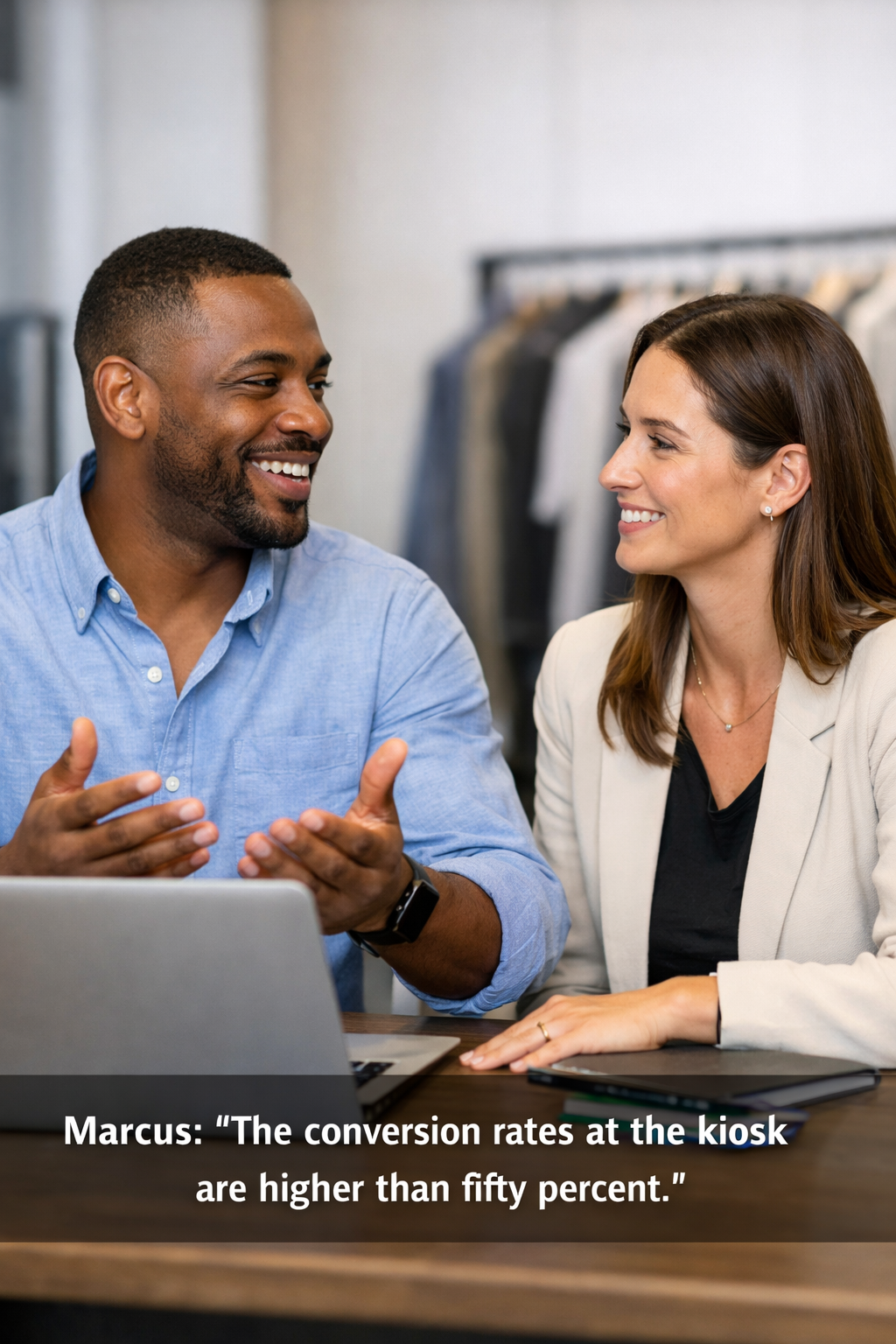
Marcus watched the enrollment complete in three seconds. "We're seeing acquisition rates higher than fifty percent at these kiosks," he said quietly. "Our old POS process? Less than ten percent"
But Elena was focused on something else. "The AI just told her about triple points for the higher margin super brand denim. That's contextual up-selling."
"Gets better." Marcus pulled up a backend dashboard on his phone. "Watch this."
On screen, the AI continued: "Perfect! Your account is active. Now, those jeans you were looking at are in aisle four. But I noticed we have belts that customers with your style preferences rate high—it's actually on sale and would give you even more points. Want to see it?"
The woman followed the AI's directions, selected the super brand jeans and belt, and headed to checkout with two higher margin items instead of one low margin product.
"Up-sell and Cross-sell," Elena whispered. "The AI is actively merchandising."
"While educating about loyalty mechanics in plain language," Marcus added. "No fine print confusion. No surprise exclusions at checkout. Customer service complaints in pilot stores are down forty-two percent. Associate stress—" he smiled "—immeasurable improvement, but significant."
THE BREAKTHROUGH MOMENT
LATER THAT DAY
They observed dozens of interactions. A retired teacher learning she had enough points to get a jacket for free, with the AI explaining exactly how her purchase qualified. A college student redeeming points for the first time, the system proactively showing him which items were eligible and which weren't—before he reached the register.
But the moment that changed everything came at 2:17 p.m.
A man in his forties approached the kiosk, mentioning a promotional email. "I got this coupon for twenty percent off, but I don't understand what I can use it on."
The AI's response was immediate: "I can clarify that for you. Your twenty percent discount works on regular-priced items, but unfortunately not on our current sale merchandise. However—" the system paused as if thinking "—I notice you're shopping near our clearance section. Several items there are actually eligible for our promotion. You might save more that way. Would you like me to show you which ones?"
"Sure."
"Great. I'm sending a store map to your phone right now, highlighting clearance items earning points. There's a jacket you passed earlier that's marked down forty percent and gives you 300 points—that's like getting an additional thirty dollars toward your next visit."
The man's expression shifted from confused to delighted. "That's actually better than the coupon."
After he walked away, Elena turned to Marcus. "That interaction just built more brand trust than a year of traditional marketing."
"And captured behavioral data worth its weight in gold," Marcus replied. "That customer's intent and purchase is now part of his profile. Next time an AI agent engages with him, for any reason, our loyalty data will make it more relevant, more personalized, more likely to be followed."
Elena understood the full implications. Retailers without full customer intent and purchase behavior data were operating blind. Their loyalty programs data unusable for AI agents. They had points and perks, promotional emails and high costs, but none of it mattered in the split-second when an agent needs to make the best possible decision.
"How long until our competitors figure this out?" she asked.
Marcus squinted for a moment. "I'd estimate eighteen to twenty-four months before the market bifurcates completely. Early adopters will dominate AI-driven discovery and recommendation. Late adopters—" he shrugged "—will have loyalty programs that technically exist but operationally don't matter."
THE WARNING
ELENA'S OFFICE
LATER THAT DAY
Elena drafted her memo to the board, choosing her words carefully:
Loyalty programs are not passive points engines. In an agentic commerce environment, they are key ingredients for differentiation, data capture, and algorithmic decisioning.
Our pilot demonstrates four critical capabilities:
1. AI-powered education that's personalized, consistent, and comprehended by customers
2. Frictionless enrollment via voice and identity-linking standards
3. Offer transparency that builds trust and reduces service costs
4. Redemption clarity at the moment that drives long-term engagement

Strategic implication: 85% of commerce happens in stores. Competitors who capture this behavioral data will dominate AI recommendations. Those who don't will become systematically disadvantaged—not because their programs are weak, but because their customer view is incomplete.
Additional concern: TikTok, Amazon, and emerging agentic platforms provide zero customer visibility. Loyalty remains our only durable mechanism for maintaining customer relationships and data capture across channels.
She paused, then added one final line—a quote that had been haunting her since Nokia’s collapse and a presentation by Stephen Elop their last CEO:
"We didn't do anything wrong, but somehow, we lost."
Elena hit send, then walked to her window overlooking the parking lot. Store visits. The most underleveraged asset in retail. The lowest-cost acquisition channel. The richest source of behavioral data.
And most retailers were treating their loyalty programs as legacy overhead rather than strategic differentiators.
The window for transformation was open. But not for long.
In eighteen months, the market would separate into two categories: retailers whose loyalty programs transformed and became and accessible to Agentic capabilities, and retailers whose programs—no matter how generous—simply never made it to the consideration set.
EPILOGUE
The technology exists. The capability is proven. The competitive advantage is measurable. The question is simple: Will you transform your loyalty program into an agentic future —or watch it become legacy overhead while competitors capture value?
The window is open. But it won't stay that way.