
Artificial Intelligence - In-Store Shopping Survival or Revival?
For more than two decades, the industry has confidently predicted the death of physical retail. Each year that prediction has been proven wrong, and yet, retailers continue to behave as if stores are a legacy channel rather than the economic engine they remain. Despite relentless investment in eCommerce, stores still account for more than 80 percent of American retail sales according to 2025 eMarketer Research. This reality is not about to change tomorrow, but what does need to change is where AI investment dollars are going. Most AI investments today are flowing toward eCommerce improvements and back-office productivity. These are useful but none of them directly touch the place or moments where most commercial value is still realized, the Store.
Retail’s biggest AI blind spot is the Store.
Stores are staffed, stocked, and operated as if customers still shop the way they did fifty years ago, even though expectations have been completely reset by Digital and AI everywhere else. Customers now walk into stores carrying supercomputers in their pockets. Most retailers treat these devices as passive screens rather than active participants in the shopping journey. That is not a technology limitation, it is a Strategic Failure of Imagination. Most in-store friction is not mysterious, customers cannot find products, associates are unavailable or under-informed, product research happens elsewhere, service quality and compliance is inconsistent. None of these are new problems, what is new is that they are now solvable. Retailers already have the ingredients required to fundamentally change the in-store experience: Smartphones, Cameras, Computer vision, Large Language Models, Loyalty data, Product data. What is missing is the decision to connect them into a cohesive and engaging in-store shopping experience. The future store experience does not have to start with kiosks, robots, or smart shelves, it can start with something far simpler, the customer’s Phone and AI.
A customer’s phone becomes their personal in-store assistant.
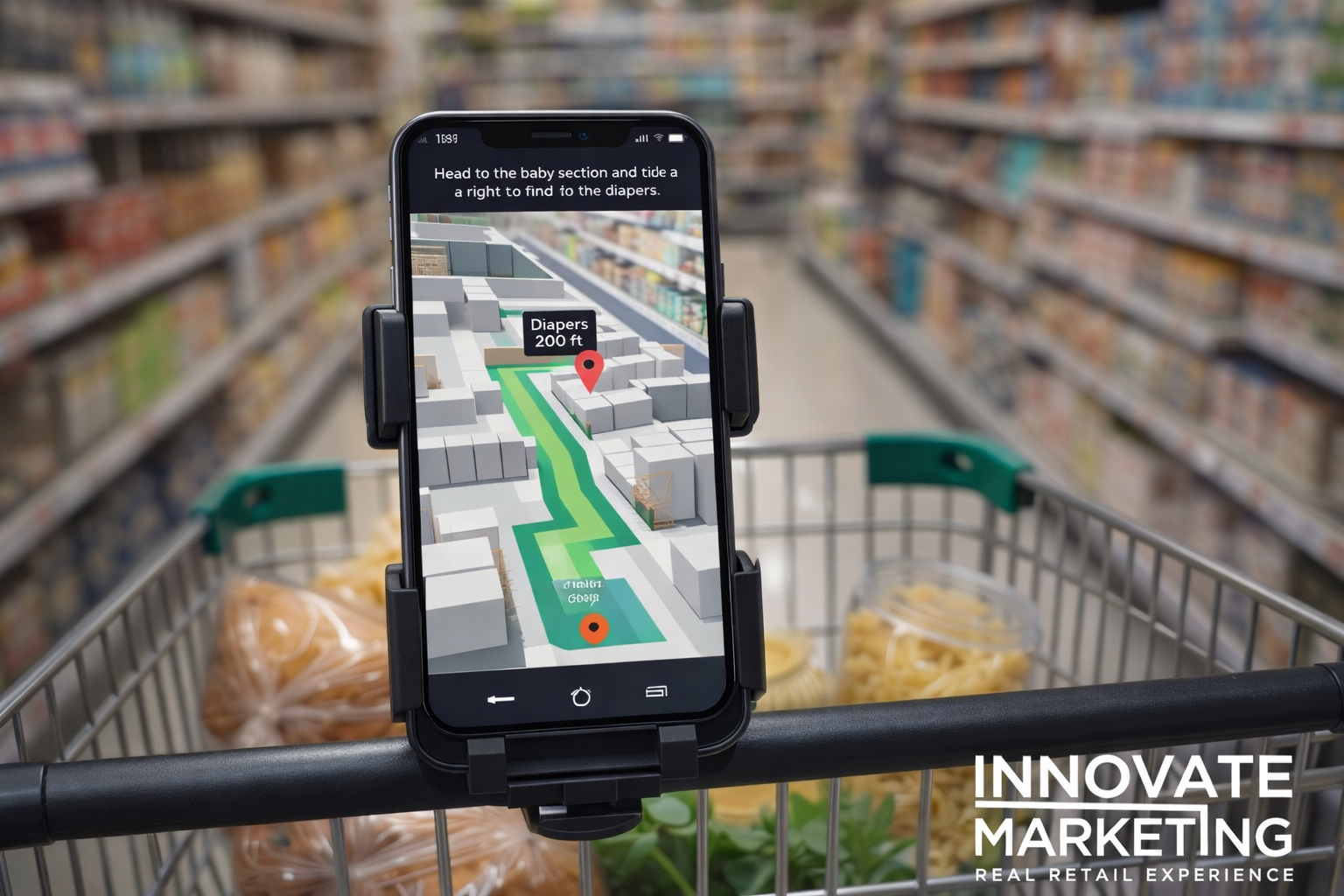
Mounted on a shopping cart or held in hand, the phone becomes a readily available companion that understands intent, location, and context. Not through clunky menus or buried app features, but through natural conversation and visual understanding.
“Where can I find diapers?”
“What’s the difference between these two products?”
“Is this the best value?”
“I bought this last month. Can I return it?”
These are not futuristic questions. They are the most common questions asked in stores today. The difference is that AI can answer them instantly, consistently, and profitably.
-
Retailers often underestimate the strategic importance of wayfinding. Just like eCommerce, product search is not a convenience feature, it is a conversion lever. When customers cannot find what they want, they do not ask more questions, they go to a competitor. AI-enabled wayfinding eliminates one of the most persistent sources of in-store friction. Using the phone’s camera and visual cues rather than brittle GPS triangulation, an AI assistant can guide customers aisle by aisle, shelf by shelf. No training required, No learning curve, No associate dependency. Once navigation exists, shopping lists turn into optimized store routes, idle walking time into curated inspiration and moments of uncertainty become moments of personalized recommendations and delight - this is where brand affinity and customer advocacy is created.
-
eCommerce has trained customers to research online. Ratings, reviews and product comparisons are mostly conducted outside the store, often on competitors’ websites or specialized, rich paid media experiences (e.g. Google Search, Perplexity). An in-store AI assistant can summarize thousands of reviews in seconds and explain differences between brands in plain language. It can contextualize products based on the customer’s needs, available store inventory, past purchases, and budget and even acknowledge competitive pricing and respond intelligently. The latter could introduce an opportunity for the retailer to virtually “negotiate a deal” with the customer rather than lose a sale, such tactics could not only defend market share and improve conversion but also create new high-value opportunities for cross-selling, up-selling and attaching complementary services sales.
-
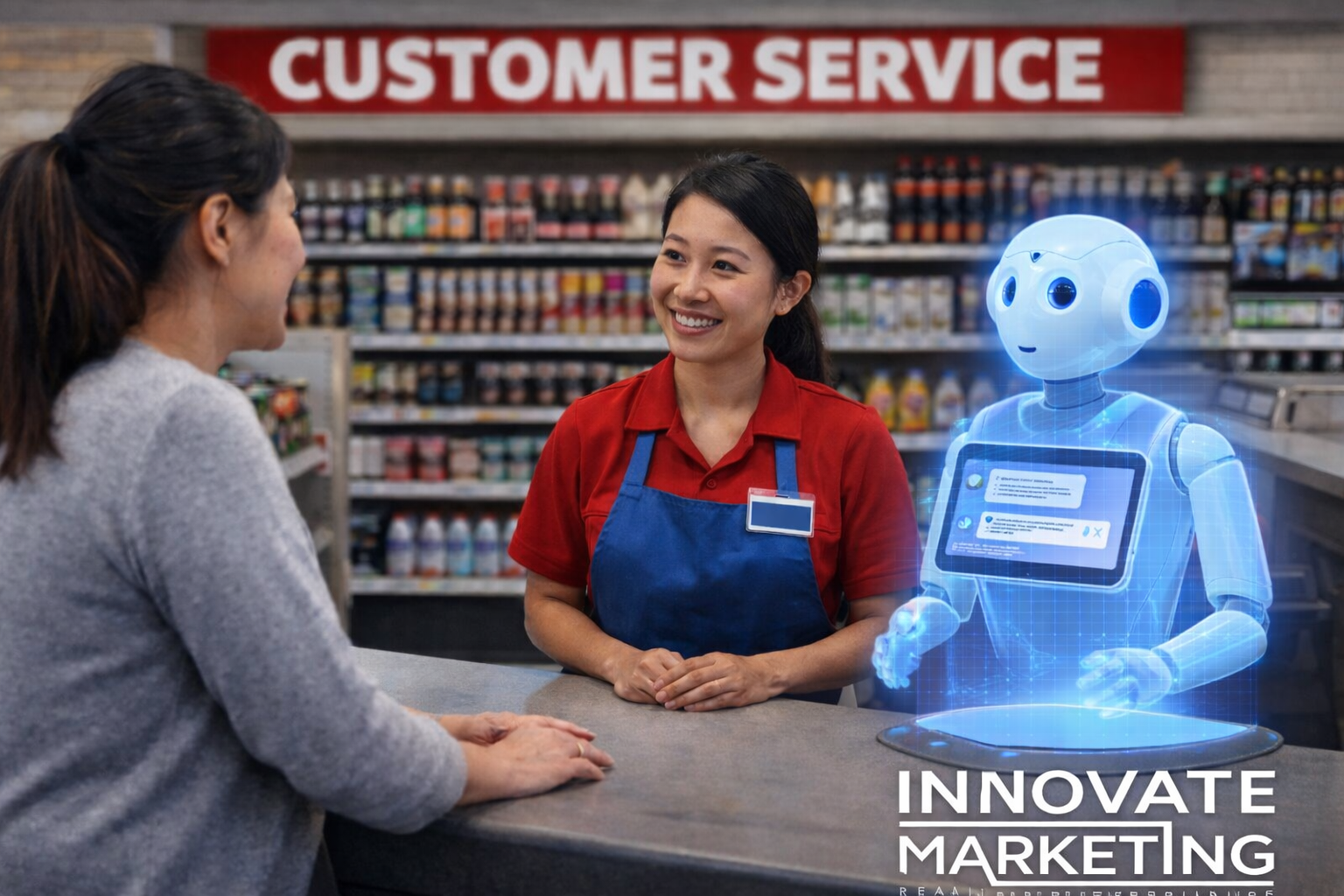
The fear that AI will replace store associates misses the point entirely. The real opportunity is to transform and super-charge associate interactions. AI-enabled associate tools can listen to customer interactions, surface relevant information in real time, and suggest offers or solutions that improve conversion and service quality. Associate training becomes simpler and can focus on behaviors and relationship building, policy application becomes consistent and customer outcomes and satisfaction improve. Furthermore, AI Agents can listen to interactions and offer Associates in the moment feedback and coaching. This is how retailers could operate with a less specialized workforce without degrading the overall customer experience. Not by lowering standards but rather by letting artificial intelligence support every customer interaction.
-
Retail media has been one of the most profitable narratives in retail over the past five years, but almost all of it was delivered on the web. When a customer’s phone becomes an active participant in the store journey that can change. Offers and Ads can be delivered based on location, intent, and timing. Content can be helpful rather than interruptive. Fun-filled Gamification as well as Surprise & Delight interactions (think Pokemon Go-like treasure hunting) can transform every store visit into unique and exciting experiences. This is not end-cap signage, nor is it large LED screens, it is personalized, permission-based influence at the exact moment purchase decisions are made.
-
Service quality is one of the most volatile and disruptive aspects of retail performance and customer relationships. From automated issues logging to purchase history lookup, policy explanation and resolution guidance, AI can ensure that every service interaction can be delivered in a consistent and qualitative manner. AI-Enabled service decisions can account for context, customer value, and long-term relationships rather than just rigid rules. World-class service stops being dependent on individual heroics and becomes systemic ensuring that each customer service request is not only handled correctly, but also with a touch of personalized differentiation.
The potential benefits of these tactics are enormous, small improvements in in-store conversion rates translate into meaningful bottom-line EBITDA contributions. Improved NPS and customer satisfaction significantly de-risk churn. Reduced levels of associate specialization create new workforce labor optimization opportunities and lower training costs, while automated in-the-moment post-interaction AI associate coaching improves customer satisfaction as well as policy and process compliance.
The next generation of Retail winners will be defined by how AI was applied in the physical world. These Retailers will stop treating stores as a fixed-cost relic of the past, and start viewing stores and customer traffic as tangible, unrealized opportunities.