
Why Re-Engineering Your Targeted Offer Process Around AI Will Define the Next Wave of Retail Winners

Key Insights (TL;DR)
-
Agent-assisted workflows reduces cycle time and improves output quality but preserves the same sequential handoffs, approval gates, and headcount dependencies that limit offer volume and speed of learning in the first place.
-
When the process is designed around AI agent capabilities rather than retrofitted with them, cycle time compresses from weeks to days, offer volume scales without proportional headcount, and A/B optimization becomes the default rather than the exception.
-
Every properly instrumented offer generates data that improves the next one. An organization running thousands of offers per year builds a learning base that an organization running dozens cannot replicate quickly. The gap will become structural, not operational.
-
The organizations most at risk are not those who have not yet started. They are those running AI pilots without asking the deeper architectural question: if we designed this process today, from scratch, would it look anything like what we are running?
AI is enabling new capabilities that will fundamentally change most marketing processes. This begs the question: what would a targeted offer process look like if it were designed from scratch, with AI agents at its core rather than layered on top? The answer to that question is where a real competitive advantage lies and the window to act first is narrowing.
The question is not whether AI can improve your offer process. The question is how you will choose to apply AI and what the consequences of this choice will be twelve months from now, when the retailers who moved quickly have already gained a lead that will be difficult to follow.
What We Mean by a Targeted Offer
Before examining how AI changes the equation, it is worth being precise about the type of promotions we are talking about. A targeted offer, as defined here, has three characteristics. First, it is extended to a specific audience and is not broadly advertised or available to every customer. Second, the customer is required to take a specific action to receive its benefit. Third, the benefit itself can take the form of a discount, bonus points, or some experiential perk.
This matters because targeted offers sit at the intersection of customer data, commercial intent, and behavioral economics. They require coordination across multiple functions, they carry measurable cost implications, and they are one of the most effective tools a loyalty or marketing team can employ. They are also the type of promotions that are most constrained by the operational architecture of the organizations that run them.
The Traditional Workflow
The traditional targeted offer process follows a familiar pattern. A Category Manager or VP of Merchandising identifies a business need, typically a category performance gap, a competitive threat, or a seasonal objective. That need is handed to a Senior Loyalty or Marketing Manager to translate into an offer design. A Loyalty Analyst then builds the audience, sizes the cost, and models expected performance against historical benchmarks, when such benchmarks exist. The offer design is approved, Copy and Creative teams produce the supporting assets, Operations deploys the offer across the required systems, and the Analyst tracks and reports results.
In practice, this process typically spans four to eight weeks from initial brief to live deployment in large retail organizations, largely due to sequential handoffs across Merchandising, Analytics, Marketing, and Operations. The bottleneck is not intelligence, every person in that chain is capable, the bottleneck is resource prioritization and hand-offs. Given finite analyst time, creative capacity, and operational bandwidth, most retailers can only run a limited number of targeted offers at any given time. That constraint caps volume, limits experimentation, and slows the ability to respond to opportunities.
The Agent-Assisted Workflow
The agent-assisted flow keeps the fundamental process architecture intact but introduces AI at specific stages to reduce cycle time and improve the quality of outputs. It is the most common form of AI adoption in retail marketing today, and it generates real, measurable value.
An AI solution trained on historical offer performance can surface recommended offer structures for the Loyalty Manager to review and select from, rather than requiring the team to develop recommendations from scratch. The same system can accelerate the Analyst's work, reducing the time required to size audiences, run cost projections, and generate insights from days to hours. When it comes to Copy and Creative, AI generation tools can produce multiple variants for human review in a fraction of the time a traditional creative briefing process requires.
The results are meaningful: task efficiency improves, more offers can be executed at a lower level of effort, and the consistency and quality of outputs tends to increase when the AI is well-trained on program mechanics and historical performance data.
What the agent-assisted path does not change is the fundamental structure of the process. The same stakeholders are still involved. The same approval gates still exist. The same sequential handoffs still govern the timeline. You are running a faster version of the same race, not changing the track.
The Re-Engineered Agentic Flow
In this example, rather than asking how AI can improve the existing process, you ask: if the process did not already exist, how would you design it given what AI agents can now do? The answer produces something that looks very different from what most retail marketing teams operate today.
In the re-engineered agentic flow, the AI agent itself identifies the need. It monitors category and customer performance data continuously and surfaces the need for a commercial stimulus before a human team would typically notice it, along with a set of recommended treatment options that include projected costs, risk profiles, and likely performance outcomes. The Category Manager's role shifts from identifying and briefing to reviewing, challenging and deciding.
Once a treatment option is selected (and the solution may include multiple audiences and offer combinations rather than a single target), agentic content creation tools produce A/B-testing Copy and Creative options for each offer variant. These are reviewed, refined, and approved by the Marketing and Merchandising stakeholders before deployment. Critically, the agent then sets up the selected offers directly in the required systems, eliminating all potential bottlenecks in the process.
The campaign does not launch to the full audience immediately. It launches in “learn” mode to ten percent of the targets, allowing the agent to identify the top-performing audience sub-segments and offer combinations before the remaining ninety percent receive anything. This kind of pre-optimization is only possible because the effort required to build, deploy and refine multiple offer variants is so much lower. In a traditional or even agent-assisted environment, running five simultaneous offer variants against different audience sub-segments would be prohibitively resource-intensive.
After the offer is fully launched, performance is tracked continuously. If underperformance is detected, the agent identifies the root cause and recommends follow-on offers designed to address it. The process does not end at deployment; it closes the loop.
Agentic Safeguard Considerations
The degree of autonomy introduced in the re-engineered agentic flow is precisely what makes it powerful, and what also makes governance non-negotiable. Four safeguard disciplines are essential. First, human control points must be deliberately designed into the workflow at every juncture where commercial, legal, or regulatory exposure is material. The agent recommends and executes; humans approve and are accountable. Second, AI-enabled targeting decisions must be subject to continuous bias monitoring, not a one-time review at implementation. Audience selection logic can drift in ways that are invisible without active audit, and the consequences of undetected bias in a promotional context carry both reputational and regulatory risk. Third, agentic content creation tools must be thoroughly briefed on brand guidelines, tone-of-voice standards, and category-specific restrictions before they generate a single customer-facing asset. A brand that moves fast but communicates inconsistently erodes the trust it is trying to build. Fourth, offer performance results must be externally validated on an ongoing basis to detect optimization drift, where the agent is technically meeting its objective while quietly undermining a broader commercial or customer experience outcome. Speed without governance is not a competitive advantage, it is the path to accelerated risks and potential liability.
Comparing the Three Workflows
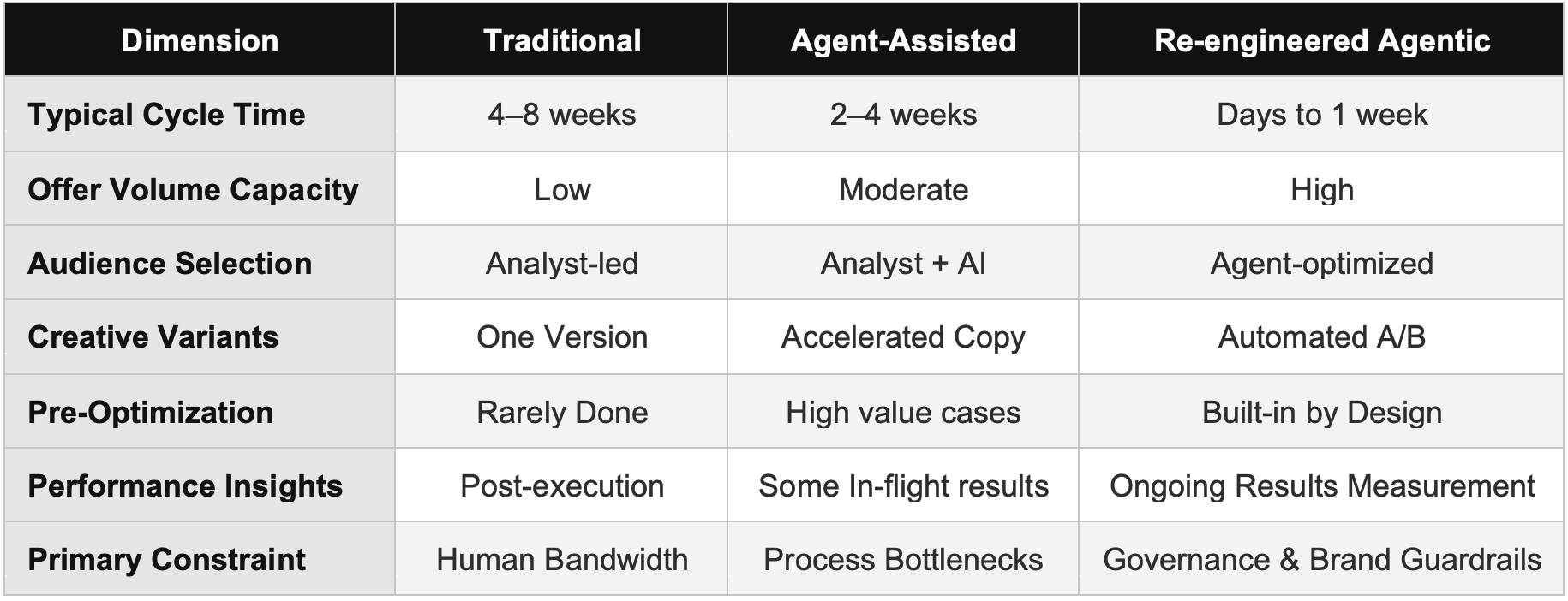
The table below summarizes the key differences between the three workflows. It is important to note that the ability to pursue one flow vs. another will vary based on your organization's current capabilities, data maturity, governance frameworks, and appetite for transformation. But it is equally important to be honest about what each path does and does not deliver.
The Compound Advantage
Every targeted offer, when properly instrumented, generates data about audience response, offer mechanics, creative performance, and timing, that data improves the next offer. An organization running forty targeted offers per year accumulates a meaningful learning base. An organization running four thousand accumulates one that cannot be replicated quickly. The gap between early agentic movers and late followers is not just the realization of financial benefits sooner, it is about the systemic accumulation of learning and application of insights.
McKinsey research has found that retailers with well-integrated personalized marketing and pricing programs achieve a two to four percentage point improvement in gross margin dollars compared with standard mass promotional approaches. At scale, for any meaningful retail operation, that is not a rounding error, it is a key transformational outcome.
The retention benefit is equally significant. Adoption of real-time personalization tools has been associated with a fifteen to twenty percent improvement in customer retention, according to Deloitte. In an environment where customer acquisition costs continue to rise, retention improvements at that scale represent substantial commercial value
Strategic Implications for Retail Leaders
Organizations do not have to move sequentially from traditional to agent-assisted to agentic workflows. Some organizations with the appropriate data foundations, the right technology architecture as well as visionary leadership will find it more efficient to move directly toward agentic redesign, perhaps beginning in one category, channel or audience segment before scaling. Others will find that the agent-assisted path delivers the ROI required to fund a deeper transformation.
What is not a viable long-term position is staying in the traditional path and treating AI as a future consideration. The competitive dynamics are moving too fast. The retailers that design their offer processes around agentic capabilities now will not simply run more efficient promotions, they will accumulate actionable insights that improve with every offer execution, creating an advantage that becomes progressively harder for competitors to close.
The organizations most at risk are those that are running AI pilots without asking the deeper architectural question. Bolting AI onto a broken process makes the process faster, it does not fix it. The question worth asking in your next planning cycle is not: how are we using AI in our offer process? It is: if we designed this process today, from scratch, would it look anything like what we are running?
For most retail organizations, the honest answer is no, but the organizations that will embrace this opportunity will be able to quickly move towards an 'always on' autonomous world where intelligent systems governed by constraints and rules work continuously to optimize marketing actions towards desired customer outcomes - a perpetual motion machine that optimizes marketing results.